
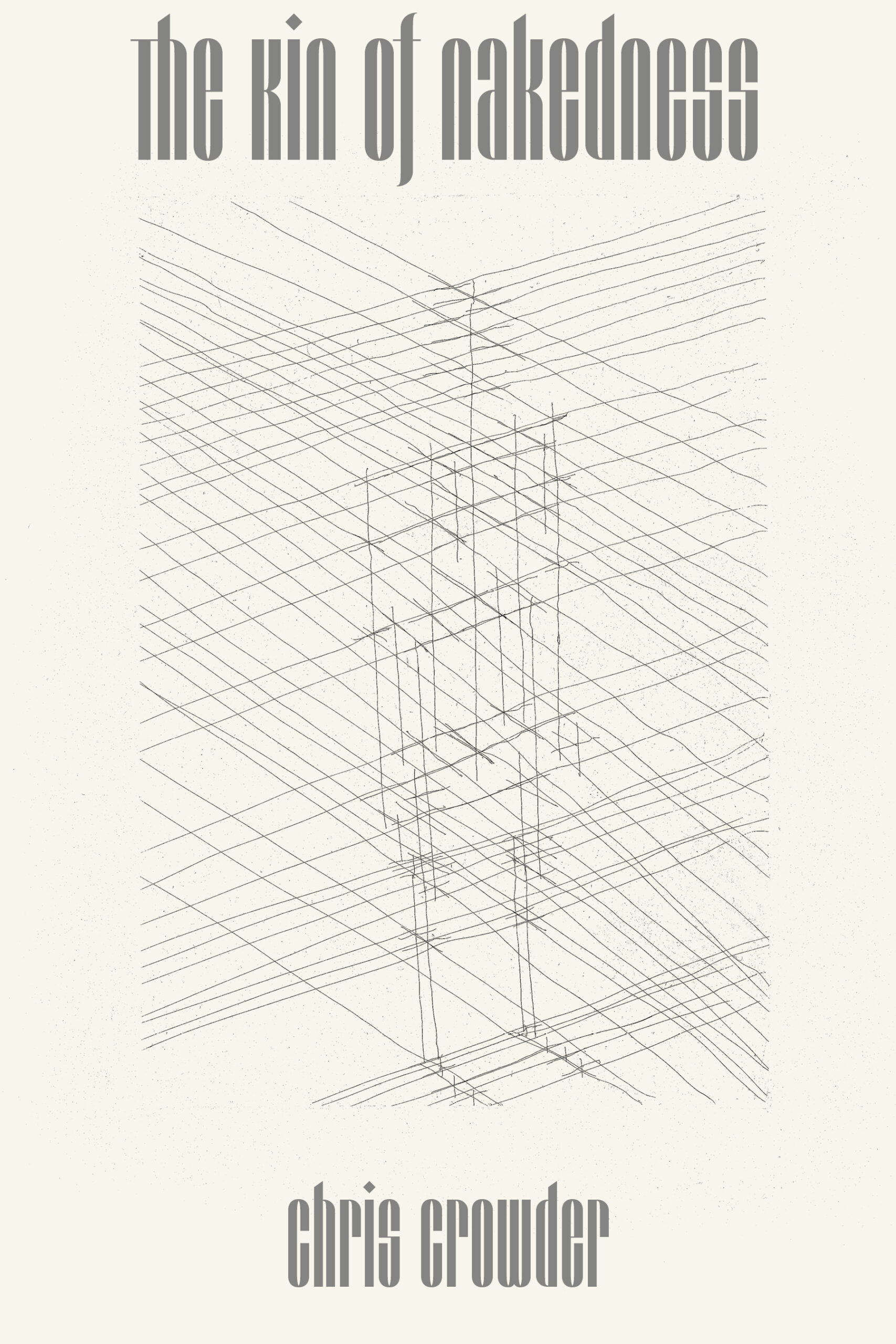
paper • 112 pages • 17.95
ISBN: 978-1-961897-72-4
eISBN: 978-1-961897-73-1
March 2026 • Poetry
The debut collection from Adroit Managing Editor Chris Crowder, The Kin of Nakedness interrogates the ethics of complaining and self-work beginning with a lens focused on body image. Structured by sections that complicate the biblical definitions of servitude—being Christ’s hands and feet—and a long ars poetica, the speaker risks toward honesty as he explores his struggles and privileges as a Black and biracial man. “Digging for everything I have to write into my flesh,” Crowder works to witness the harm done to himself and others who are competing for recognition. Seeking to understand these internal and external struggles, he embodies characters, including benched quarterbacks and Jimmy Fallon, while reckoning with fractured subjects like greedy pastors and alternate universes.
In wrestling with despair, Crowder neither refuses reality nor surrenders to nihilism. The speaker of “I’m Not Always Sulking, Resting My Elbow on a Well” admits to the temptation to surrender, saying, “I can’t trick my anxious ass into thinking that things aren’t better than this,” but the elaboration of “this” becomes a litany that contradicts the insufficiency of this life: “My corgi, Eden. My parents’ garden of beans, collard greens, and spicy peppers. Reacting to heat: it’s actually got good flavor to it. So do the worst days.” Crowder has a signature gift for distilling the bizarre beauty of this existential maelstrom, the succor beside the suffering. He achieves an astonishing inverse transmogrification that shows man capable of God’s metamorphosis: not the body into bread, but the abyss into being. “Before I had skin, I hated it. / The idea.” But, though our nakedness terrifies us, the mortification of the flesh is its capacity to feel every excruciating and ecstatic thing. “Lord, // you asked me what sense / could you not bear / to lose? My answer, now, is touch.”
Tantrum
I stomp on
God’s foot.
He gasps—
like a gossiper.
Unhurt and entirely
interested. He says
Watch yourself. And I
let it out. HOW CAN
I WATCH MYSELF
EXIST. IF I AM ONLY
WATCHING MYSELF EXIST.
IF I’M ONLY WATCHING MYSELF
EXIST, I’M YOU. I’M NOT YOU, CAN’T BE LIKE
YOU IF I AM WATCHING. OR MAYBE THAT’S ALL YOU
DO. ALL YOU ARE. IS A MIRROR. SAY I’M ONLY ALL I
SEE SOMETIMES. I’M ONLY ALL I SEE SOMETIMES.
In a remarkable ars poetica, Chris Crowder reveals he seeks “the specific flash of pain.” He searches mirrors, sundown towns, masculinity, and God. But he doesn’t hunt self-flagellation’s devotional torment. Rather, the painful awareness that the Almighty knows nothing of his vulnerable body, even as it was He who created what might harm it. What Crowder finds, page after enthralling page, is pain as a site of power and powerlessness. And below that brutal asymmetry? Want. The Kin of Nakedness is gentle and merciless, at turns Blackly comic, ever shucked to stark reckoning, and quietly unsettling.
Is a man constructed from the inside out or the outside in? Is the cruelest eye to behold a person always their own? What does it mean to desire but despise or distrust the body? How do we accept the body as holy when it’s subtly and simultaneously commoditized? These are just a few of the questions that constellate Chris Crowder’s debut, The Kin of Nakedness, a collection full of humorous verve interwoven with hard-earned humility and insight. These are poems that, in their inventiveness, disguise that they are powerful provocations. Readers will arrive at the end of the book having been reformed, our perception shifted a few degrees more toward kindness to ourselves and others despite our faults and psychic fault lines. This journey is well worth it. I encourage you to take it.
Hurray for Chris Crowder’s The Kin of Nakedness! There is so much irreverence and beauty and novelty in this debut. The speakers in these poems wander unceremoniously in and out of sacred spaces, as Crowder moves the needle on spiritual banter. The voice is at once raucous and vulnerable. The language that results is jarring, strange and disruptive. Every jolt forward in ascension is yanked back through metaphysical fallout, and I find myself guffawing at times—just at the way he puts things. The scenarios he creates. The way he picks fights with people who are not even there—sometimes angels, sometimes Jimmy Fallon! Mostly, though, the tensions in The Kin of Nakedness are in place to draw upon the age-old internal struggle: the face of judgment, says this incredible emerging poet, is the face of the self and the divine.